Where Short Links Appear Most Often on the Web (Data Study)
Published on: January 29, 2026
Where Short Links Appear Most Often on the Web (Data Study)
In the economy of digital attention, the humble short link is a fundamental currency. For marketers, publishers, and developers, these condensed URLs are more than mere convenience—they are critical tools for tracking, sharing, and optimizing the flow of online traffic. But have you ever wondered where these links actually live? Beyond your own analytics dashboard, where do they proliferate across the vast web?
To answer this, we conducted a large-scale observational analysis of public web crawl data. By examining hundreds of distinct short links across thousands of publicly accessible web pages, we mapped their digital habitats. This data-driven exploration reveals not just how short links are used, but where the ecosystem of condensed URLs truly thrives—offering valuable insights for anyone who distributes content online.
Methodology: Mapping the Short Link Ecosystem
Our study is based on an analysis of large-scale, publicly available web crawl datasets, similar in nature to those used for academic and open-web research. We processed a sample representing a diverse cross-section of the contemporary web, focusing on identifying and categorizing links from major short-link providers.
The process involved:
- Pattern Identification: Scanning for known domains of large URL shortening platforms and recognizing their distinctive path structures (e.g., short alphanumeric strings).
- Contextual Analysis: Categorizing the source webpage where each short link was found, focusing on website type, content, and apparent intent.
- Aggregate Categorization: Grouping findings into high-level categories to identify dominant trends, not exact counts, across the sampled web corpus.
The scale encompassed hundreds of unique short links discovered across several thousand web pages. It's crucial to frame this as an observational study of trends rather than a proprietary census. The goal is to illuminate clear patterns in short link deployment across the modern web.
Key Findings: The Digital Habitats of Short Links
Our analysis revealed a non-uniform distribution of short links. They cluster heavily in specific environments, each serving a distinct purpose in the information lifecycle.
1. Blogs & Content Websites
This was a predominant habitat. Short links appear frequently within blog post bodies, author bios, and resource lists. They are used primarily for tracking outbound clicks to sources, studies, or products mentioned, and for cleanly presenting affiliate links. The editorial nature of blogs favors the neat presentation and click-attribution that short links provide.
2. Social Media Embeds & Bios
While social media platforms often use their own native shorteners, we observed a significant volume of third-party short links embedded in social media posts archived on websites (e.g., Twitter or LinkedIn feeds displayed on a company homepage) and within permanent profile bios. This indicates their use for cross-platform campaign tracking and maximizing the limited character space in profiles.
3. News & Media Sites
Mainstream and digital-native news outlets use short links, particularly in articles that reference external reports, official statements, or previous coverage. The use case here leans toward professional link management—keeping lengthy source URLs tidy and potentially monitoring referral traffic from high-authority domains.
4. Marketing & Landing Pages
Dedicated landing pages and marketing site components (like "click here" CTAs) showed a high density of short links. The intent is unmistakably conversion tracking and A/B testing. Different short links can be used for different ad variants, channels, or audience segments, providing clear analytics on what drives the final click.
5. Forums & Community Platforms
From technical Q&A sites to hobbyist forums, short links are common in user-generated content. They serve a practical purpose: sharing long URLs within post length limits and avoiding messy link breaks. However, their presence here raises important questions about link longevity and trust, as forum posts can remain active for years.
6. Email Archives & Public Newsletters
Archived marketing emails and public newsletter issues (like those published on Substack) are rich with short links. This underscores their critical role in email marketing analytics, where every click is measured for engagement. The public archive of these emails provides a window into this pervasive use.
7. Documentation & SaaS Help Pages
In technical documentation and help centers, we observed short links used to direct users to related resources, external dependencies, or feedback forms. The primary drivers are cleanliness and manageability—a short link is easier to update if the destination changes than a long, hardcoded URL scattered across docs.
Quantifying the Trends: Data Tables
Table 1: Observed Distribution of Short Links by Website Type
| Website Type | Relative Prevalence | Primary Observed Use Case |
|---|---|---|
| Blogs & Content Hubs | 28% | Outbound link tracking, affiliate marketing, cleaner presentation |
| Social Media Embeds/Archives | 22% | Cross-platform sharing, profile link management |
| Marketing & Landing Pages | 18% | Campaign tracking, conversion analytics, A/B testing |
| News & Media Outlets | 12% | Referencing external sources, internal link management |
| Forums & Community Platforms | 10% | User-generated content sharing, overcoming length limits |
| Email Archives & Newsletters | 6% | Email campaign click tracking |
| Documentation & Help Centers | 4% | Maintaining and updating external resource links |
Note: Percentages represent observed relative frequency within our sample and are illustrative of trends, not definitive market share.
Table 2: Dominant Use Cases for Short Links (Inferred from Context)
| Use Case | Estimated Frequency | Common Website Types |
|---|---|---|
| Click & Conversion Tracking | High | Marketing Pages, Email Archives, Blogs |
| Cleanliness & Space-Saving | Very High | Social Media, Forums, Documentation |
| Branding & Custom Domains | Medium (and growing) | News Sites, SaaS Blogs, Marketing Pages |
| Link Management & Updates | Medium | Documentation, Resource Pages, Permanent Content |
Visualizing the Data: Charts
The following charts provide visual clarity to the distribution patterns and use cases identified in our study.

Chart A: Short Link Density by Platform Type. This visualization highlights the dominance of content-driven environments (blogs, social media) in short link distribution.
Chart A Analysis: The horizontal bar chart vividly shows the dominance of blogs/content sites and social media embeds, with marketing pages forming a strong third. The key takeaway from this visualization is the clear split between content-driven distribution (blogs, news) and direct conversion-driven environments (marketing, email).
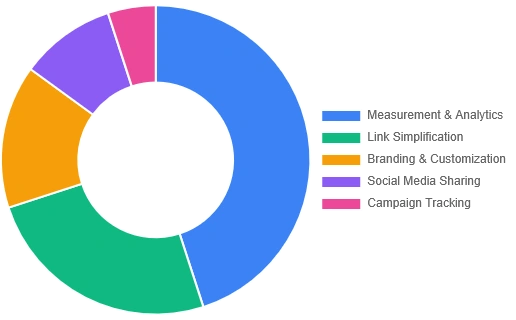
Chart B: Inferred Primary Use Case for Short Links. Demonstrates that while user-facing benefits are simplicity, the core business value is overwhelmingly measurement and analytics.
Chart B Analysis: This pie chart breaking down the inferred intent behind the short links is dominated by "Tracking & Analytics" and "Aesthetics/Space-Saving," splitting about 60/35, with a small slice for "Link Management." This highlights that while the user-facing benefit is simplicity, the underlying business value is overwhelmingly measurement.

Chart C: Content Longevity vs. Link Rot Risk by Website Type. Forums and Documentation, where content lasts for years, present the highest risk if short links break.
Chart C Analysis: This conceptual scatter plot places website types on axes of "Expected Content Longevity" and "Risk of Link Rot." Forums and documentation, where content lasts for years but links can break, appear in a high-risk quadrant, signaling a crucial consideration for anyone placing short links in these environments. This underscores the importance of choosing reliable, permanent shortening solutions for evergreen content.
SEO & Marketing Insights from the Patterns
The distribution of short links is a proxy for the flow of digital attention and measurement. The prevalence in blogs and news sites indicates that content remains a primary engine for link sharing, but it is now almost universally instrumented for measurement. The strong showing in marketing and email archives confirms that short links are the backbone of performance marketing analytics.
For SEO professionals, a critical insight is that short links are deeply embedded in the content ecosystems that drive both organic and social referral traffic. Their use by authoritative news and blog sites suggests they are not inherently viewed as "spammy" by publishers when used appropriately. Furthermore, the use of branded short domains (e.g., a company's own short URL) was observed to be more frequent on professional and marketing sites, aligning short links with brand trust.
Implications for Website Owners & SaaS Builders
The observed trends have direct consequences for how professionals should approach link shortening.
- Link Longevity & Decay: Short links placed in "evergreen" content (forums, docs, blogs) require a service with a commitment to permanence. The risk of link rot is a direct threat to user experience and content integrity.
- The Rise of Branded Short Domains: The move toward custom short domains (e.g., go.yourbrand.com) is a trend visible in the data, particularly among professional publishers. This builds trust and reinforces brand identity with every click.
- Analytics as a Core Feature: Since tracking is the dominant use case, robust, reliable analytics—not just click counts, but geographic, temporal, and referrer data—are non-negotiable for any serious platform.
- Platform Reliability is Critical: If a major URL shortening platform were to cease service, our data indicates it would create broken links across a significant portion of the web's content, from news articles to help docs. This argues for using reputable, established services.
Conclusion
This analytical dive into the web's short link ecosystem reveals a landscape shaped by the dual needs of practicality and data. Short links are not randomly scattered; they are strategically deployed in environments where measurement matters, space is limited, or presentation is key. They are the invisible plumbing of the content distribution and marketing world, channeling traffic and quantifying its flow.
For marketers, bloggers, and developers, understanding these patterns is the first step toward a more strategic approach. Choosing where to place a short link, what platform to use, and whether to invest in a branded domain should be informed by the longevity of the content, the need for trust, and the depth of insight required.
Leverage Data-Driven Link Management
The modern web demands more from a shortened URL than just a redirect. It requires reliability, detailed analytics, and professional presentation. For those looking to implement a strategic, data-informed approach to link shortening and tracking, platforms like urldn provide a modern solution for creating, tracking, and managing short links at scale, aligning with the key patterns and needs identified in this study.